OpenFishbanks - A Web Based Fishing Economy Simulator
Description:
I built OpenFishbanks to study how people behave when they share a resource that regenerates slowly and can be depleted quickly. The original MIT Fishbanks exercise gave me the basic structure, although its short, synchronous format limited the kinds of long‑term strategies that could appear. I wanted a system that ran continuously, supported a large population of players, and produced a complete digital record of every decision. That goal shaped the entire project.
I implemented the platform with Django and hosted it on an AWS EC2 instance. I used Celery with Redis to update fish populations, ship earnings, and market conditions on a fixed schedule. I modeled fish populations with a logistic growth function and tied player revenue to ship capacity, species availability, fuel costs, and harbor fees. I created a trading system that let players exchange ships and currency freely. Every action flowed into a Sqlite3 database, which gave me a full dataset for later analysis. I opened the simulation to students and faculty for six days, and nearly two hundred people registered.
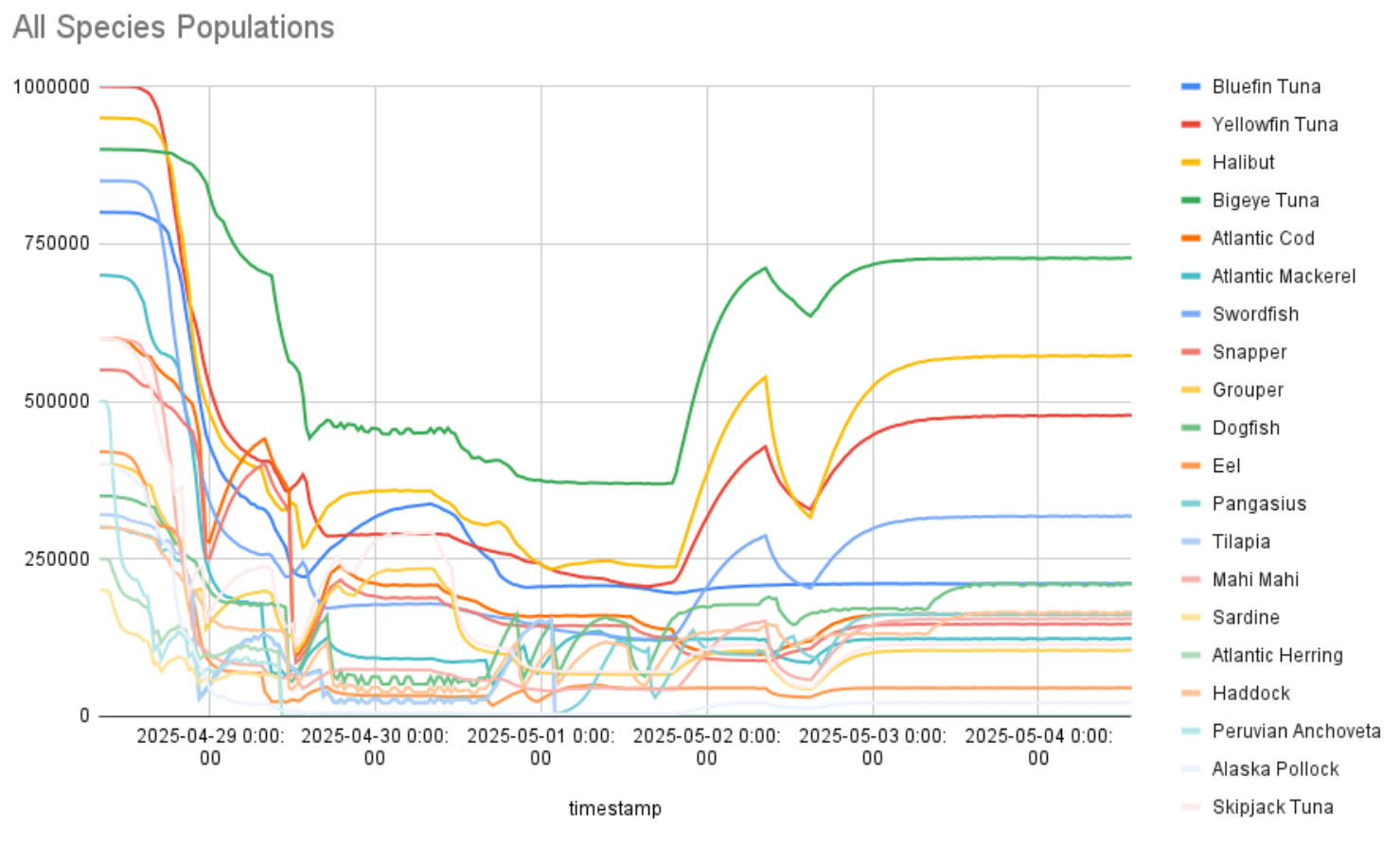
I watched the fish populations collapse early, recover slightly, and then oscillate as players moved their fleets. I calculated a Gini coefficient of 0.9778 at the end of the run, which reflected extreme wealth concentration. A small group of players reinvested early profits and accumulated large fleets. Other players formed alliances, traded preferentially within their groups, and attempted to corner the ship market. A few participants overfished aggressively to damage the earning potential of their competitors. These patterns produced a system marked by ecological decline, economic consolidation, and coordinated strategic behavior.
I designed the project to reveal how people act in an unregulated common‑pool environment. The results showed rapid exploitation of the resource, strong incentives for early capital accumulation, and the emergence of cooperative and adversarial groups. The simulation demonstrated how persistent digital environments can surface long‑term dynamics that short classroom exercises never capture.
Tools:
All the tools that I used in this project:
Python Django HTML+CSS Javascript AWS EC2 Redis Celery Nginx Gunicorn Sqlite3 LATEX